 VIASONDE
For issue seven of the Viasonde Zine, we focus on Portland’s Shadowlands, whose new album, 004, is out now. Learn about how family shapes creativity, the special sauce behind their atmospheric guitar tone, and Amy’s go-to Karaoke cuts.
 We’re coming up on the ten-year anniversary of 001. Looking back, what were some of the biggest challenges you faced while making that record that no longer existed by the time you were writing and recording 004?
Amy: With 001, we were still throwing the proverbial spaghetti at the wall to see what would stick. We were trying on a lot of things and even switching around instruments a bit, such as Amy playing drums on a track or Casey singing.
The numbered release convention keeps things intentionally minimal and open-ended. If 004 had a traditional title instead, what do you think it would’ve been called?
Amy: Albums are so hard to name, so we decided pretty early on to be cheeky and stubborn about it by forever sticking with numbers. To make matters worse, we wanted to imply that hundreds of records would be created by using three-digit numbers. Still don’t know what we’d call 004, but we’d likely pick lyrics from The Worst Light.
 I read that 004 was largely created during the pandemic era. Did that forced slowdown ultimately help refine the album, or did the distance and isolation make the creative process more difficult?
Amy: That’s a bit of a misquote or maybe a confusing statement on my part. I really didn’t write much at ALL during the pandemic. I’ve always been someone with a lot to say and a lot of emotions, but I found myself not only going inward but wanting to be quiet and not take up space. It was partly due to feeling isolated and partly due to the social unrest and the de-closeting of some very nasty things in our society that I’ve always been aware of. We had a few songs that we started writing late in the pandemic, but most of the album was written in the last year or so before the record came out.
Are there plans to tour in support of 004, or has touring become more complicated for Shadowlands at this stage of the band?
Amy: Touring has always been complicated for us. But we are going to do some touring and plan to get down to SF this summer, making some stops along the way. We’d love to get out to Denver/Chicago and nearby places, but right now it’s just a fun idea and we haven’t started serious planning.
 Gear question, only because I feel every interview needs at least one. Angie, Jesse, and Amy: do you each have a favorite pedal or piece of gear that’s become essential to your sound over the years?
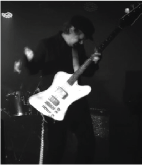
Jesse: I do! I hand-built a little bass preamp pedal based on the ROG Ginger (itself an Ampeg bass preamp pedal) that sounds so much better than the stock preamp on my amp that it’s always on. I also like to make a lot of little interstitial UFO and vacuum cleaner noises, which a CBA mood and a Meris Polymoon are great for.
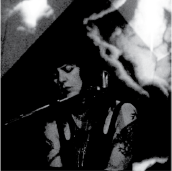
Amy: I have a vocal effects pedal board that is 100% guitar pedals, thanks to this great little Eventide–Casey put it together with input from me, and we share it with his other project. I also love our Korg Prologue synth. I love that the keyboard can be split into two different voices and that it has analog filters.
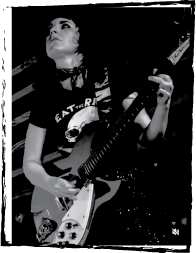
Angie: I play a Rickenbacker 330 through a Roland JC 120. It provides a chime-y, bell-like quality that adds a unique tone uncommon for bands we have sonic overlap with. I think it shifted the Shadowlands sound overall from what you hear on 001 and 002.
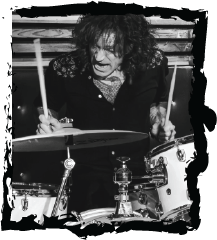 This one’s for Casey… In modern darkwave and post-punk, it’s become increasingly common for bands to rely heavily on drum machines. Shadowlands stands out because your drumming brings a real sense of dynamics and physical expressiveness to the music. Were there particular drummers, records, or even individual songs that shaped your approach?
Casey: Although I cut my teeth musically in an obsession with early punk, my musical inspiration, and what I listen to has been very expansive since. When I first started playing drums in bands, I was in punk bands, so many of my major influences came from bands like the Subhumans and the Dead Kennedys. When Shadowlands started, some of my bigger influences came from bands like Echo and the Bunnymen, Joy Division, Bauhaus, Can, and even some of Radiohead's more experimental songs/albums – especially when they use drum machines alongside live drums. We do a fair amount of that, which is a really enjoyable way to approach songwriting as a drummer, yet exceedingly challenging. My approach is always to try to be as musical as possible, and I always appreciate a drummer who can play a lot more than they often do, but set their ego aside to play what’s right for the song. Today, I am still learning and finding bands that inspire and influence me. Everything from. Oranssi Pazuzu, Idles, Nation of Language, Lume, and far too many others to mention.
Shadowlands is unique in that it’s built around twins, spouses, and longtime collaborators. I imagine there’s a kind of creative shorthand that comes with that closeness. What are some of the benefits and challenges of working within such tight personal relationships?
Amy: The band started with Casey and me playing music in his garage with another friend for fun- we realized right away we needed to do something with it. I pulled Jesse in to play bass immediately. Angie replaced our original guitarist right as we started writing 003 and has done an amazing job. While we had performed a lot together as kids, we had never been in a band before, and it felt like the time was right. Our relationship as twins was in a place where we could let our special creative connection shine, because sibling stuff just wasn't going to be an issue. I’d say one of the biggest benefits is how this can help close communication gaps- and while we all do this well, Angie and I in particular have a lot of nonverbal communication that is helpful. Everyone gets along and enjoys each other, but in the rare case that there is an issue with communication, it’s usually me not being able to explain an idea– someone can almost always jump in to translate if folks aren’t understanding each other. When I bring in a song, I rely on the band to take a mood or feeling I’m trying to capture and turn it into a song, which does take good translation skills. Everyone in the band brings in ideas, and we’re all pretty open to whether or not the song feels right. At this point, I’d say there just aren’t any notable challenges. I don’t know if that’s just because of the personalities in the group, but we all get along super well. It helps that we all share one common goal: enjoying making music and spending time together. If someone is having a bad day, we talk. If we miss band practice for a week or two, I start to get weird and feel like something is missing.
Jesse, building on that... you and Amy have played together in multiple projects over the years. How has your musical communication changed or deepened by the time you reached 004?
Jesse: I’d like to think so! We’re both pretty good at feeling out whether an idea is working or not pretty early, and we’re both fine expressing that. There’s also a lot of nonverbal communication that happens after all of those shared hours of playing together: we both can pretty easily intuit what the other person is looking for.
 Portland’s music scene has always felt incredibly vibrant and stylistically varied. Do you think the city and its creative community have had a strong influence on Shadowlands’ evolution, or has the band always functioned more as its own insular world?
Jesse: Little bit o’ both! We mostly just sort of make music that we’d like to listen to, so that’s kind of an insular thing, but when we started out as folks from the punk/garage world trying to break into the minor key/spooky/synthy club circuit, we found so many lovely and inspiring people that their influence must have crept in somehow! Amy: We got out to as many shows as we can, and we have a lot of friends who are also in bands, so that has to rub off on us.
Horror synth and cinematic textures kept coming up while I was researching for this interview. Amy, what horror soundtracks or composers influenced the darker arpeggios and cinematic flourishes in Shadowlands?
Amy: I love Halloween, Suspiria, and The Fog. I am not sure I can draw a super direct line from their compositions to my songs, but if there’s a hint of that on the record, I feel good about it. I am also a lifelong superfan of the Cure, and I love the layers and atmospheric quality of their music. If we had endless hours in a studio, we’d be doing more of that.
Amy, I read that karaoke helped you become more comfortable stepping into the role of front person. What are the go-to songs for a night at the karaoke bar?
Amy: My favorite type of karaoke song is a fall-to-your-knees, dramatically powerful ballad or anthem. I’m never quite that dramatic with the band; I am standing behind a double-decker keyboard station, after all, BUT it’s helped me feel less self-conscious and take myself less seriously by singing some bad (or good) hair-metal ballads. I always felt that free person inside of me, and karaoke helped it to come out.
003 was released through the French dark-music imprint Icy Cold, while 004 arrives through the US-based Seeing Red Records. Was there a particular reason or philosophy behind the move to Seeing Red for this release?
Amy: Gosh, not really, other than we thought it might be slightly simpler to work with a label here in the US that also has distribution in Europe, so we asked around a bit, and Seeing Red was interested in working with us… We love Icy Cold, still. We also like that Seeing Red seems interested in so many different genres, because we like to pull from lots of different styles.
Shadowlands @ Instagram / Bandcamp / Facebook